Monday, January 23, 2012

Preventive Maintenance Alone is not Enough to Eliminate Breakdown

Sering sekali kita mendengar beberapa perusahaan menerapkan program preventive maintenance tetapi jumlah equipment yang mengalami breakdown tidaklah berkurang secara signifikan. Pertanyaan sebenarnya apakah preventive maintenance sendiri bisa mengurangi bahkan menciptakan zero breakdown.
Berdasarkan prinsip reliability engineering, penyebab equipment breakdown berubah terhadap waktu. Hal ini bisa dijelaskan dalam “life span charateristic curve” atau yang biasa disebut dengan bath-up curve. Gambar berikut memperlihatkan bath-up curve dan hubungannya dengan penyebab dan strategi yang bisa digunakan sebagai countermeasure.


Ketika mesin/equipment dalam kondisi baru, failure rate pada awalnya tinggi dan perlahan-lahan turun seiring dengan penyesuaian kondisi operasi equipment dengan proses. Dan, pada akhirnya failure rate akan menjadi lebih stabil pada periode tertentu, dan pada akhir umur equipment tersebut, failure rate akan naik (wear-out failure period).


Early period, accidental period dan wear-out period memiliki penyebab yang berbeda. Hal ini terlihat jelas pada gambar diatas. Oleh karenanya untuk mencapai zero breakdown yang diinginkan karateristik dari breakdown tersebut harus diketahui dengan baik sehingga pencegahan (countermeasure) bisa diimplementasikan secara spesifik.


Penyebab failure pada state awal (early period) adalah adanya kesalahan pada tahap desain dan manufaktur. Untuk mengatasinya, team desain harus melakukan tes terlebih dahulu sebelum benar-benar terpasang dan beroperasi. Dengan mengembangkan prosedure tes ini diharapkan semua kelemahan yang ditemukan bisa dilakukan improvement untuk mengkoreksi semua weakness yang ditemukan sehingga meminimalisasi kegagalan pada saat pengopersian.


Accidental failure disebabkan terutama oleh kesalahan yang disebabkan oleh pengoperasian equipment dengan tidak benar. Dan yang paling efektif untuk pencegahannya adalah menjaga agar equipment tersebut bisa beroperasi dengan benar dan tepat.


Wear-out failure disebabkan oleh terbatasnya umur alami dari sebahagian atau keseluruhan part dari sebuah equipment. Masa pakai equipment tersebut bisa diperpanjang dengan cara preventive maintenance dan improvement dari sisi maintainability nya (melalui perubahan di design). Hal ini bisa mengurangi failure rate di akhir masa pakai dari equipment tersebut.


Dari ketiga tipe failure yang terjadi, maintenance prevention adalah metode yang paling efektif untuk mencegah sebuah equipment mengalami failure/kegagalan oleh ketiga tipe tadi. Juga, maintenance free equipment design haruslah menjadi pemikiran utama pada saat design dari sebuah equipment sehingga ketiga tipe failure tersebut bisa dicegah. Oleh karena itu preventive maintenance sendiri tidak mampu untuk mengeliminir breakdown equipment. Sehingga jelaslah bagi kita bahwa semua bagian turut serta bertanggung jawab. Mulai dari design/planning, operation department dan tentu saja departement maintenance.


Source : Seiichi Nakajima, “Introduction to TPM” Productivity Press.
Wednesday, November 9, 2011

Reliability Equipment and it's related to safety

Reliability of equipment is so related to safety. It is very clear explained by Joel Levitt in his article at UPTIME magazine edition August – September 2011. This Joel stated that there are four reasons reliability and EHS are related (Below is the four reasons):

Reason 1: Something was broken and had to be repaired. The breakdown caused the person to go into harm’s way. So, lack of reliability can cause death and injuries.
Equipment running as designed does not require people to enter a confined space, repair (and touch) exposed electrical wires, pressure test a generator, sit on top of a tank and weld, or even fall off of a ladder. How is reliability related to safety? Reliability removes risk from the equation, and the worker is not in harm’s way. If no one was welding above the tank, the explosion would not have happened; if there was no repair needed, no one would give been up on the ladder or on the roof.
A. Something breaks down and has to be repaired.
B. The breakdown causes a worker to be in harm’s way.
C. Reliable equipment does not require maintenance workers to be put into harm’s way.
D. The best solution to a hazard is to eliminate it.

Reason 2: Due to PM, the size and scope of repair is smaller, making for safer repairs.
The second part of the equation has been reported by Exxon-Mobil. They studied their maintenance-related accidents and found the following: “Accidents are 5 times more likely while working on breakdowns then they are while working on planned and scheduled corrective jobs.” High reliability implies an effective PM program that catches deterioration before it causes a failure. Since the asset is not yet broken, it is safer to work on.
A. PM activity catches deterioration early in the process before failure (and reliability is impacted).
B. At that point the repair is smaller, safer, and more manageable, resulting in fewer EHS incidents.
C. PM also gives managers more time to plan and deal with hazards.

Reason 3: Hazards are eliminated or mitigated
High reliability also implies that the maintenance planners have time to plan the job properly. One aspect of planning is to consider all the hazards and figure out and describe a way to accomplish the work safely. The job plan that an experienced planner develops will reflect the safe way to do the job. A planner should look at every job and see if any common hazards
are present. Hazards would include: airborne contaminants, falls from heights, slipping and tripping, falling objects, eye damage (particle, chemical, or flash), chemicals (ingestion, skin exposure, or breathing), asphyxiation, radioactive exposure, fire, explosion, electrocution, entrapment and crushing, and temperature stress. Every hazard identified is then eliminated (best option) or mitigated (second-best option). The safest plants are the ones where the safety of the workers is considered at every step in the job preparation process.
A. The planner plans the job to minimize downtime
B. The planner is specifically trained to look for hazards to safety, health, and environment.
C. Planners will mitigate or eliminate the hazard in the plan before the crew even leaves the shop.
D. The result is fewer EHS incidents and more reliable equipment.

Reason 4: Planned jobs allow fewer opportunities for the maintenance
worker to improvise.
Improvisation is statistically less safe than following the job plan with the correct tools and spares. One of the building blocks of a reliable culture is adequate maintenance planning. Without planning, the workers are forced to make do with what spares and tools they can find. To do their job, they may have to improvise to make things work. Improvisation might be great in the theater but can be deadly in maintenance. My guess is that the following worker was making do with an improvised support: Worker was performing maintenance on the back of a trash truck. The support gave way and the tailgate came down on the worker.
A. Improvisation is great in comedy.
B. Improvisation can be deadly in maintenance.
C. Adequate time for job planning means having the right tools, spares, equipment, skills, and drawings when the job starts.
D. The result is fewer EHS incidents and better reliability.
Reliability is the outcome of this intentional maintenance environment and is essential for a safe environment.

Tuesday, November 8, 2011

Safety Improvement Implementation

Jadi, bagaimana memulai implementasi SHE (Safety, Healthy and Environment)? Untuk menjawab pertanyaan tersebut, terlebih dahulu harus dipahami beberapa prinsip dasar yang berlaku, yaitu :
  • Tidak ada yang ingin mengalami kecelakaan
  • Tidak ada orang yang ingin melihat orang lain mengalami kecelakaan
  • Hukum dan system adalah keniscayaan
  • Kita bisa menghasilkan lebih banyak bila bekerja sama
  • Apa yang dapat diukur pasti dapat dikerjakan
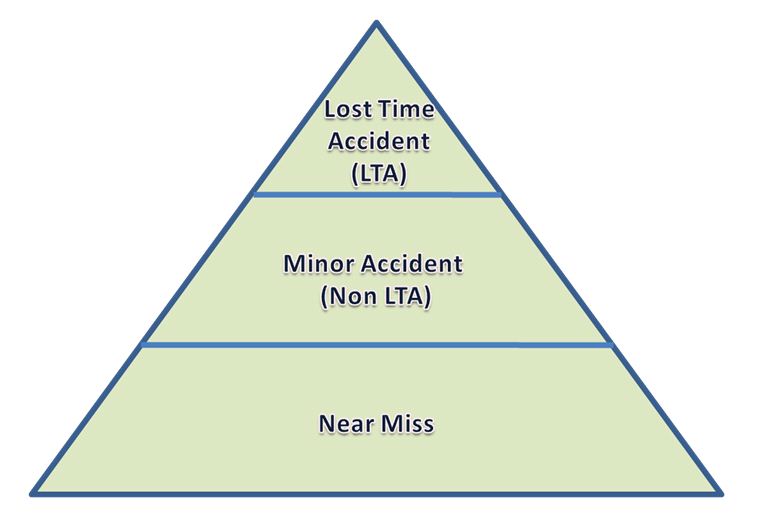
Berdasarkan safety piramid yang lebih dikenal dengan Heinrich Principle yang ditemukan oleh Herbert William Heinrich yang mengatakan bahwa satu kecelakaan fatal dimulai dengan 29 kecelakaan ringan dan diawali dengan 300 kejadian yang hampir menyebabkan kecelakaan (near-miss). Dalam piramida dapat digambarkan sebagai berikut :
Heinrich Principle

Di dasar dari piramida safety tersebut adalah unsafe condition and unsafe behavior.

Untuk memulai SHE implementation khususnya untuk safety, kita harus mulai dengan mencari semua sumber unsafe condition dan unsafe behavior tersebut. Cara menemukan item-item tersebut di lapangan bisa dilakukan dengan cara melakukan survey ke lapangan/shopfloor dan dari kegiatan autonomous maintenance (AM). dari kedua cara tersebut, temuan unsafe condition dan unsafe behavior seharusnya operator lah penemu yang paling banyak. Dengan training tentang AM1 dan 7 tipe abnormal dimana salah satunya adalah tempat-tempat yang tidak aman. Operator bisa menemukan sebanyak mungkin area di sekitar mereka yang tidak aman yang bisa menimbulkan kecelakaan.

Dari list temuan-temuan tersebut bisa dilakukan improvement. Improvement tersebut bisa berupa menghilangkan penyebab kecelakaan tersebut. Bila tidak bisa dihilangkan berarti harus diberi tahu tentang kondisi di area/equipment tersebut dengan membuat marking dan memperlengkapi mereka dengan alat perlindungan yang sesuai standard (dengan Personal Safety Equipment yang tepat), sehingga ketika operator tersebut melewati area tersebut, mereka bisa memperlengkapi diri sehingga kecelakaan bisa dicegah.

Juga, analisis terhadap near miss dan NLTA harus dilakukan. Analiss yang dilakukan untuk mencari akar penyebab near miss terjadi. Dari hasil analisis tersebut bisa ditemukan apakah hal tersebut bisa dihindari dengan cara improvement atau mengendalikan/control sumber penyebab kecelakaan.

Jadi, bila sumber bahaya tersebut tidak dapat dihilangkan hanya bisa dikontrol, apa selanjutnya yang harus dilakukan? Dalam tulisan selanjutnya hal ini akan dikupas tuntas.

Sunday, November 6, 2011

Fact on safety and health at work ILO

Berikut ini adalah data dari ILO (International Labour Organization) 2009 tentang data keselamatan kerja. Berikut kutipannya.

  • The ILO estimates that each year about 2.3 million men and women die from work-related accidents and diseases including close to 360,000 fatal accidents and an estimated 1.95 million fatal workrelated diseases.
  • This means that by the end of this day nearly 1 million workers will suffer a workplace accident, and around 5,500 workers will die due to an accident or disease from their work.
  • In economic terms it is estimated that roughly four per cent of the annual global Gross Domestic Product, or US$1.25 trillion, is siphoned off by direct and indirect costs of occupational accidents and diseases such as lost working time, workers’ compensation, the interruption of production and medical expenses.
  • Hazardous substances cause an estimated 651,000 deaths, mostly in the developing world. These numbers may be greatly under-estimated due toinadequate reporting and notification systems in many countries.
  • Data from a number of industrialized countries show that construction workers are three to four times more likely than other workers to die from accidents at work.
  • Occupational lung disease in mining and related industries arising from asbestos, coal and silica exposure is still a concern in developed and developing countries. Asbestos alone claims about 100,000 deaths every year and the figure is rising annually
Artinya, rata-rata 6301 meninggal akibat kecelakaan dan penyakit di tempat kerja setiap hari dengan hampir 1783 diantaranya terjadi akibat kecelakaan fatal. Dan jumlah ini bisa bertambah terutama di negara berkembang dimana safety belum menjadi budaya kerja. ILO juga mengatakan bahwa jumlah ini bisa bertambah karena di beberapa negara berkembang sistem pelaporan kecelakaan kerja tidak bisa diakses atau dilaporkan. Juga, kerugian financial yang ditimbulan sangat besar dari kecelakaan tersebut.

Jadi, Masih tidak mau peduli dengan safety?

Wednesday, November 2, 2011

Planned Maintenance

Ada beberapa hal yang perlu diperhatikan dalam menjalankan planned maintenance dengan baik. Beberapa diantaranya adalah :
1. Implementasi secara penuh 5S (Seiri, Seiton, Seiso, Seiketsu dan Shitsuke) sehingga sikap mental kearah perubahan mulai terbentuk. Mulai dari mengorganisasi setiap equipment, membuat setiap equipment tempat yang semestinya, membersihkan equipment secara teratur sehingga pondasi sikap kearah perubahan mulai terbentuk.

2. Pembuatan KPI untuk planned maintenance ini harus sesuai dengan kebutuhan perusahaan dimana KPI ini didefenisikan dengan jelas. Juga, KRA (Key Result Area) juga diidentifikasi untuk mempermudah tingkat keberhasilan implementasi. Biasanya KPI ini berasal dari PQCDSM (Productivity, Quality, Cost, Delivery, Safety dan Morale) yang didefenisikan untuk maintenance.

3. Philosophy/prinsip dari zero failure dipahami sebagai prinsip bersama dengan konsep yang sama. Pemikiran lama seperti "All equipment can fail" harus diubah menjadi "don’t let equipment fail" atau "Failure can be reduced to zero".

4. Hubungan planned maintenance dengan pillar lain sangatlah erat. Tidak ada pillar dalam TPM yang berdiri sendiri. Hubungan pillar planned mainteance dengan pillar lain haruslah jelas dipahami hubungannya dengan FI, AM, QM, SHE, T&E , EM dan OTPM.

5. Methodology dalam menggembangkan Planned Maintenance haruslah dilaksanakan secara komperhensif. Biasanya stage pertama yang dilakukan adalah research kondisi equipment sekarang termasuk history dari failure/replacement dari equipment tersebut. Dari hasil tersebut, dibuat program planned maintenance sesuai dengan panduan step by step implementasi planned maintenance.

Perlu diingat bahwa TPM sangat constraint terhadap cost reduction. Juga, maintenance personel developement menjadi faktor yang penting dalam kesuksesan implementasi planned maintenance.

Tuesday, November 1, 2011

Migration from wordpress to blogger

I just migrated from wordpress to blogger. The wordpress blog no longger can be updated.

Kaizen Competition


Today I have attended the Kaizen competition. Actually this kaizen comes from employee suggestion especially shop floor suggestion. This is the fruit of what we spread out this couple of months in the shop floor. Every shop floor including production and maintenance look very excited and spirit of competition start to grow well here.

In the beginning, so many obstacle in the suggestion implementation. Many ideas in the shop floor can not be facilitated well and followed up until those ideas can be implemented. Moreover, many ideas from operators are rejected by managers because those manager don’t understand truly what operators mean by that suggestion. The impact is communication between management and operators are not linked well and growth gab between them. shop floor personnel do not want to give suggestion because they think if they give suggestion, management do not care their ideas and never follow-up it. And the worst part is the operator become not caring about their equipment. Just follow the instruction. If the problem happen just call maintenance, and maintenance will fix it without ever looked for root cause of the problems. And the end, blame each others!

After starting implementation TPM, we see that moral of employee need to raise up. And we start to advocate the ideas and create the system so that operators can easily give suggestion and guide them how to create suggestion. Motivating all shop floor to give suggestion create the spirit to create ideas that can be implemented and do kaizen for that ideas. Months by months the ideas become huge in number. To motivate them we do competition in division level that be attended by top management. We have to select which kaizen have to be presented by the suggester. The result is greater than what we expected. All people become very excited because they can show their ideas. We only allow the idea that already implemented and give good result can be counted in the competition.

Suggestion system is one of the way to generate idea from shop floor. I will talk more how operator can give more ideas and implemented it.